
Welding Ventilation and Its Necessity
More and more attention is being paid to employee wellbeing in production environments – including in welding workshops. Blue haze in production is a sign of inadequate welding ventilation, which poses a serious risk to workers' health.
Why is welding ventilation necessary?
Since welding fumes vary depending on the metal, the problem may even go unnoticed with some metals, while the health risk is in fact much greater. This is precisely why special attention must be paid to welding ventilation.
The most common gases found in various types of welding methods and when welding different metals:
- Nitrous oxide
- Carbon dioxide
- Carbon monoxide
- Ozone
Welding fumes may also contain various metal particles:
- Chromium
- Nickel
- Zinc
- Manganese
- Cobalt
- Copper
All of the above particles pose a serious health risk, which may manifest in the form of asthma, Parkinson's disease or cancer. In addition, small-diameter particles cause significant damage to people's lungs and respiratory tract.
How to eliminate the hazards?
There are several different ways to make welding safer. The choice depends primarily on the specifics of the particular production, the dimensions of the parts being welded, and the nature of the premises.
Extraction of welding residues and fumes near the source
The most effective way to eliminate hazardous welding fumes is a solution with welding arms. However, if the parts being produced change frequently or are too large in size, using an extraction arm can prove very cumbersome and time-consuming. In the worst case, operators will not start using the equipment that has already been acquired.
In such cases, it is sensible to use an extraction hood above the welding process area. In addition to the hood, it is worth adding lamellas to reduce the air volume required for extraction. The lighting needed for the workstation can also be installed onto the welding hood.
Forced ventilation, or Push-Pull
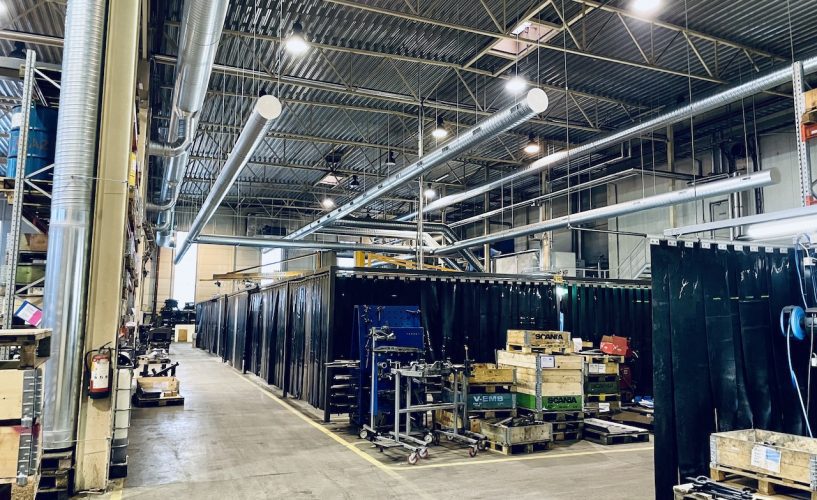
In larger industries, where the use of precision extraction systems is excessively time-consuming or even impossible, the Push-Pull welding ventilation solution is common. There are several different methods for arranging the ductwork, but this depends primarily on the specifics of the particular client's work and production premises.
The welding filters we offer clean 99.9% of the extracted air, and the already purified air is directed back into production.
Advantages of Push-Pull:
- uninterrupted operation thanks to automatic filter cleaning, which is handled by a pressure sensor with special automation;
- reduced heating costs – the air is purified and directed back into industry without losing heating energy in the process;
- with the help of automation, it is possible to ensure that the filter starts and stops depending on the welding process – the filter does not operate when no welding is taking place, and it is impossible to forget to switch it on;
- collection containers on the filters;
- the equipment can be placed outdoors or on a frame to save industrial floor space or reduce noise levels.
Welding filter tower "Airtower"
The "Airtower" welding filter is very practical in smaller industries where the welding process takes place in smaller premises. Since the device is plug-and-play, only a power supply and compressed air are required for the filter to operate.
The welding filter tower is available in two different capacities: 5500 m³/h and 8000 m³/h. The device's filters are cleaned using compressed air, and the filter service life is considered to be 4000–6000 operating hours. In the lower part of the device there is a collection box where heavier dust accumulates.
Get in touch and request a demo unit for testing, to be sure of the device's good performance before purchasing.
Welding curtains and lamellas
The simplest way to limit the spread of welding gases is to use welding curtains or lamellas. Welding curtains are available as both stationary and mobile solutions. In addition, welding booths can be successfully enclosed with lamellas, which still ensure convenient operation as well as the transport of parts in and out.
Fresh air in production
With a welding filter, we can ensure that the air in production is cleaned of residues, but this does not provide the new fresh oxygen that people and the welding process require. For this, it is essential to also consider ensuring a supply of fresh air.
Elister
Read more
Powder Coating in the Metal Industry – Quality That Is No Accident
Powder coating in the metal industry does not merely mean a proper final finish – it means more stable quality, lower powder consumption and smooth production…
From now on, Elister OÜ is the official representative of Elcometer equipment in Estonia
Elister OÜ is now the official importer of Elcometer equipment in Estonia! Elcometer is renowned for its innovative and high-quality measuring instruments that…
Powder Coating Seminar 2024!
An idea born at the beginning of summer grew into an experience-rich seminar day held directly among the products at Torm Metall, where industry leaders brough…
