

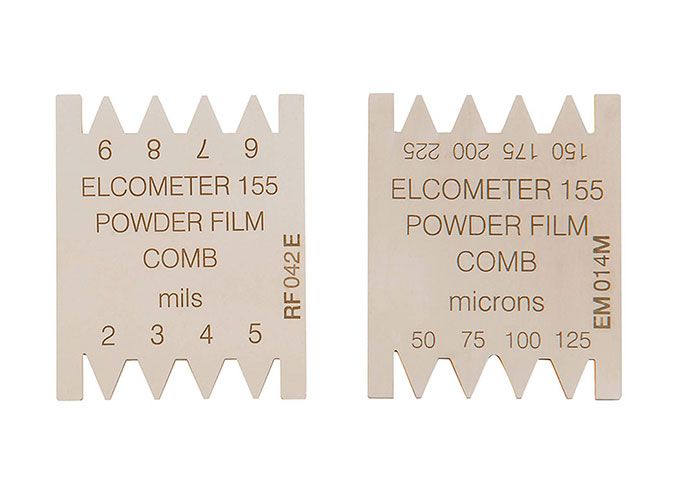
Elcometer 155 pulberkile kammid mõõteskaalaga mils ja mikronites, kaks metallist hammastega kammi

Elcometer coating thickness gauges

Powder layer comb

Powder layer comb – precise powder thickness control before curing The Elcometer 155 powder layer comb is specially designed to measure powder coating thickness before the curing process.

Powder Thickness MeasurementMeasures the powder coating layer thickness before the curing process.
Without damaging the surfaceSharp teeth allow the powder to flow without removing it, so the measurement does not damage the surface.
Universal compatibilitySuitable for metal, plastic, wood, glass and other substrates.
Compact and lightweightConvenient to use in the production line.

Elcometer 155 Powder Comb – operating principle The powder comb is placed on the freshly applied powder surface and gently drawn across it. The teeth penetrate the powder, leaving a visible drag mark. Read to the last tooth where the mark is visible – this gives the approximate powder thickness before curing.

Technical specifications

Tolerance: ±5 microns or ±0.0002 inches Wide straight lines on both sides of the teeth – help maintain a perpendicular position to the surface Suitable for: metal, plastic, wood, glass and other substrates Does not remove powder – measurement does not damage the surface Compact and lightweight – convenient to use on the production line

Why use a powder comb?

Optimise the application system before curing Reduce waste and overspray Ensure a more uniform powder coating and better adhesion Avoid costly over- or under-coating

Frequently asked questions

What is a powder comb used for? A powder comb is used to measure the thickness of the powder coating layer immediately after application, before the curing process. It helps fine-tune the application system and reduce waste and overspray.

How to use a powder comb? Place the comb on the fresh powder surface and gently draw it across the surface. The teeth penetrate the powder, leaving a drag mark. Read the last tooth where the mark is visible – this indicates the approximate powder thickness in microns or mils.

Does the powder comb reading correspond to the final dry film thickness? Not exactly. The coating thickness before curing differs from the dry film thickness obtained after curing – the relationship depends on the powder used. The comb provides an indicative guide for optimising the process, not a final measurement result.

Which substrates is the powder comb suitable for? The Elcometer 155 works with a variety of substrates, including metal, plastic, wood and glass. The straight lines on the teeth help keep the comb perpendicular to the surface, ensuring a repeatable and accurate measurement.

What is the measurement accuracy of the Elcometer 155? The Elcometer 155 powder comb is manufactured to a tolerance of ±5 microns or ±0.0002 inches, ensuring a reliable indicative reading for optimising powder application in the production process.

Tolerance±5 microns or ±0.0002 inches
Suitable substratesMetal, plastic, wood, glass and others
Less wasteHelps reduce waste, residue, and overspray.
More uniform coatingEnsures a more uniform powder coating and improved adhesion.
It looks like there may be a typo in the source text. Could you clarify the intended Estonian phrase? The text "Väldi üle- ja alikattimist" appears to contain an error. Did you mean: - **"Väldi üle- ja alakatmist"** → *Avoid over- and under-coating* - **"Väldi üle- ja alakattumist"** → *Avoid over- and under-lapping/overlap* Please confirm the intended meaning so I can provide an accurate translation.Helps avoid costly over- or under-coating.
Optimize the processEnables fine-tuning of the application system before heating.
Fast readingProvides an instant and accurate reference reading.

Need help finding the right solution?

We help you choose the solution that fits your needs and production.

Send request →
Quality materialsDurable industrial quality and long service life.
Experienced partnerWe help design, install and maintain.
Support & spare partsFast help and spare-part availability throughout the lifecycle.