

Filters for Volatile Organic Compound Control
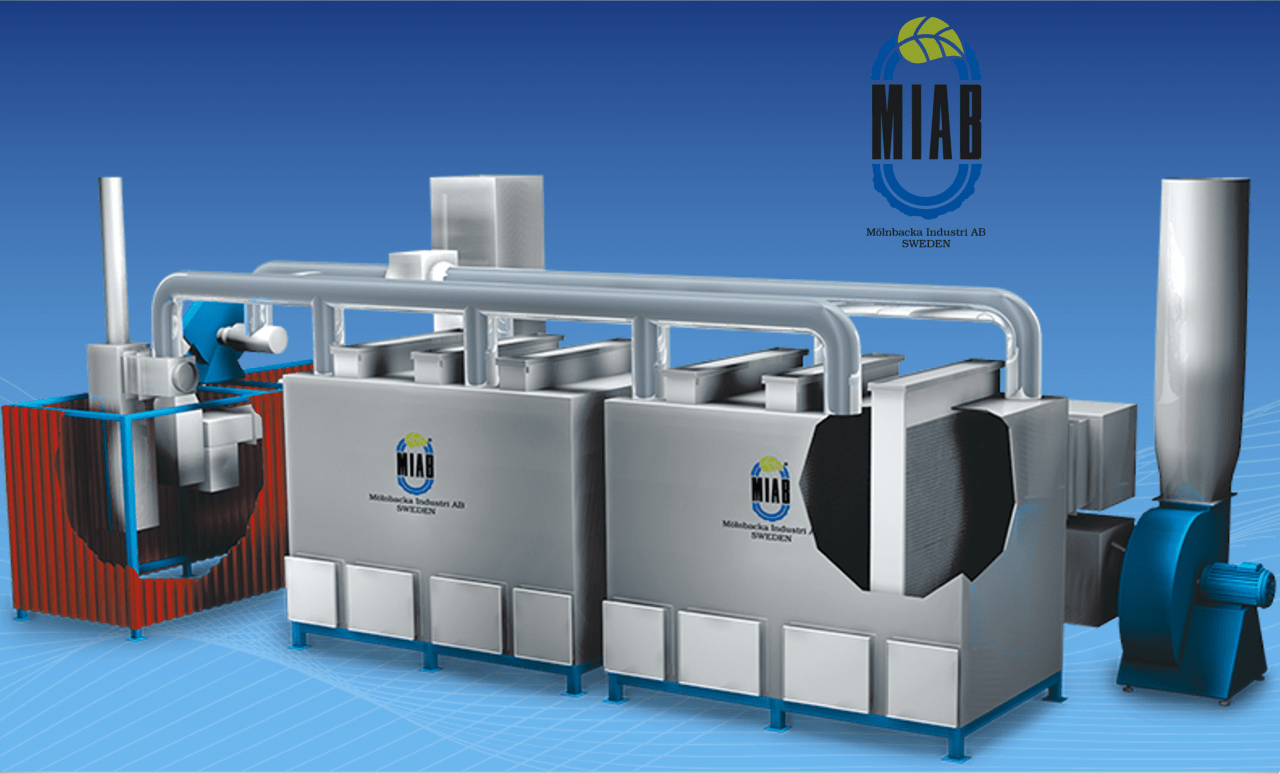
MIAB FD activated carbon filter
This type of purification system is suitable for high air volumes with low concentrations of solvents. Typical volume in the range of 15,000 – 250,000 m3/h and concentration range 0 – 1000 mg/m3
This type of purification system is suitable for large air volumes with low concentrations of solvents. The typical volume ranges from 15,000 – 250,000 m³/h and the concentration range is 0 – 1000 mg/m³.
The system consists of two parts: an activated carbon filter with the main fan's adsorption unit and a catalytic oxidation unit.
Purification takes place in two stages
- 1. Air purification and solvent concentration into the carbon filter. When the system is started, the air output of the main fan is automatically adjusted to draw process air from the emission points connected to the system. The main fan takes the contaminated air and passes it through the carbon filter. The solvent is adsorbed by the activated carbon and the air is purified.
- 2. Regeneration of the carbon filter and destruction of the solvent in the catalytic unit. When the carbon becomes saturated with solvent, the air movement in the machine's process is closed off and the carbon is regenerated using the hot gas coming from the catalytic oxidation unit. During continuous operation, a second activated carbon filter takes over the adsorption process.
Low energy consumption
During regeneration, the hot gas from the catalytic unit heats the carbon to release the solvent and carries the solvent into the oxidizer. Since the gas flow volume is smaller than the process air volume, it becomes highly concentrated, destroying the solvent vapors without additional fuel or energy. This is very important in order to achieve low energy consumption.
Common questions about this product.
Frequently asked questions
What is the compatibility range of the system's air capacity and solvent concentration?
Does purification continue uninterrupted even during carbon filter regeneration?
How does carbon filter regeneration and solvent destruction work?
Does solvent destruction require additional fuel or energy?
What are the main components of the system?
Need help finding the right solution?
We help you choose the solution that fits your needs and production.
Send request →