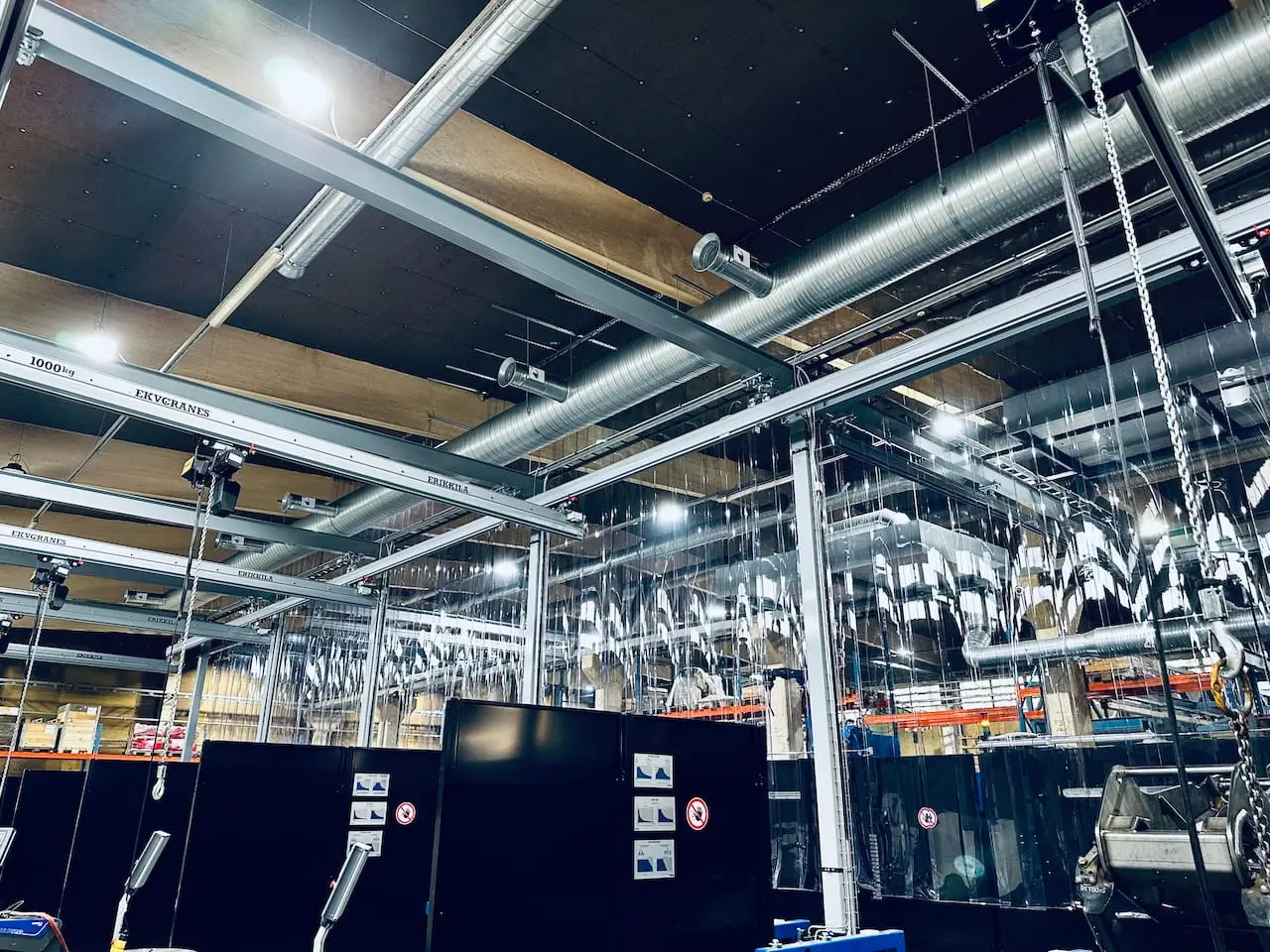
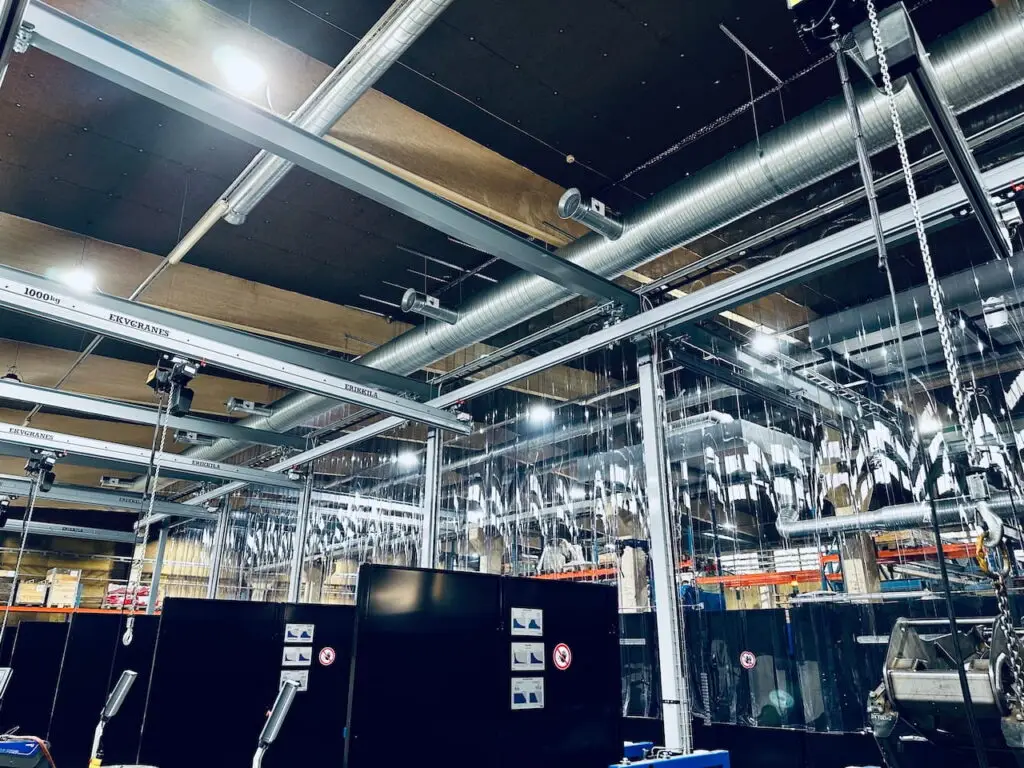
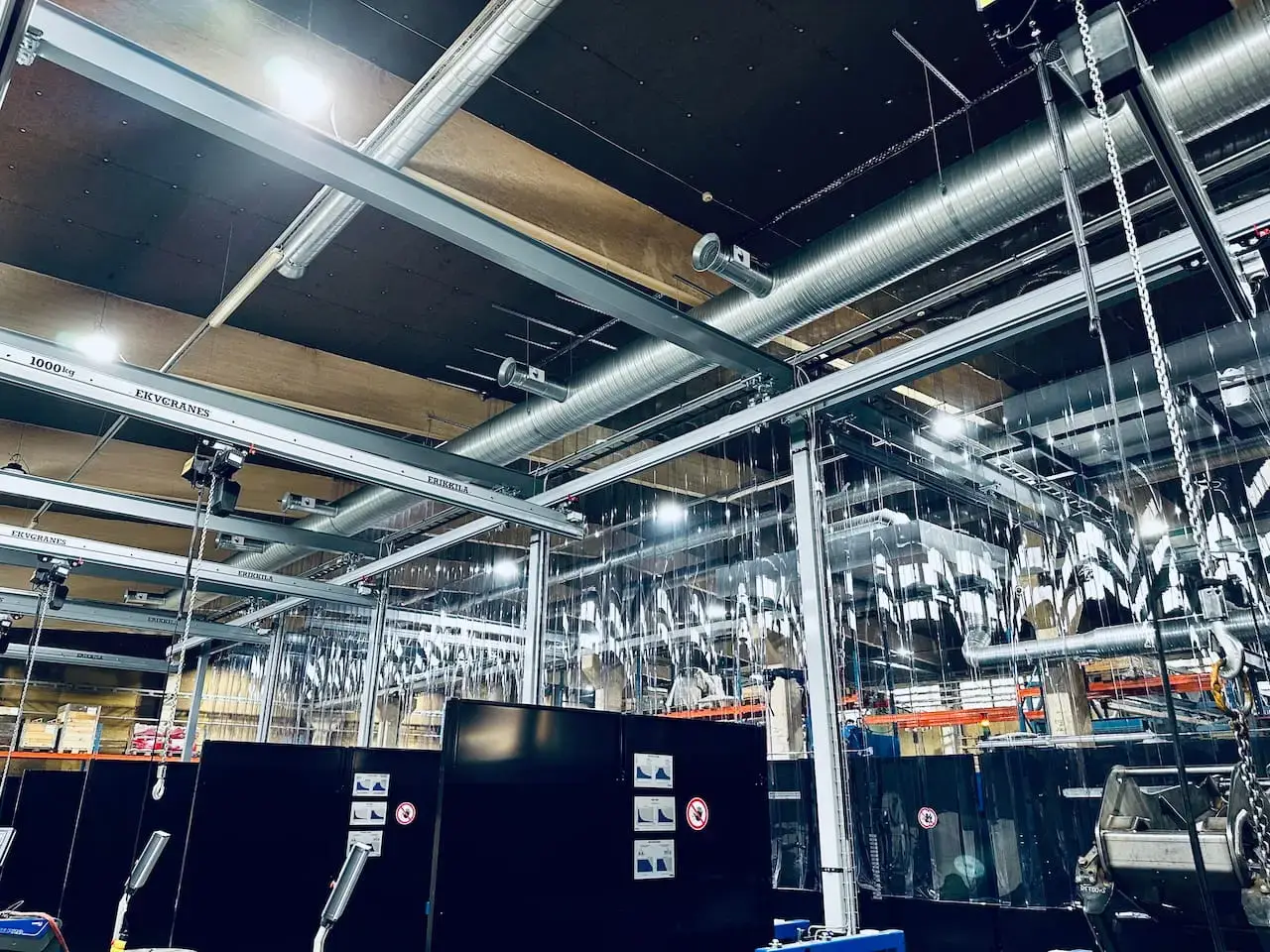
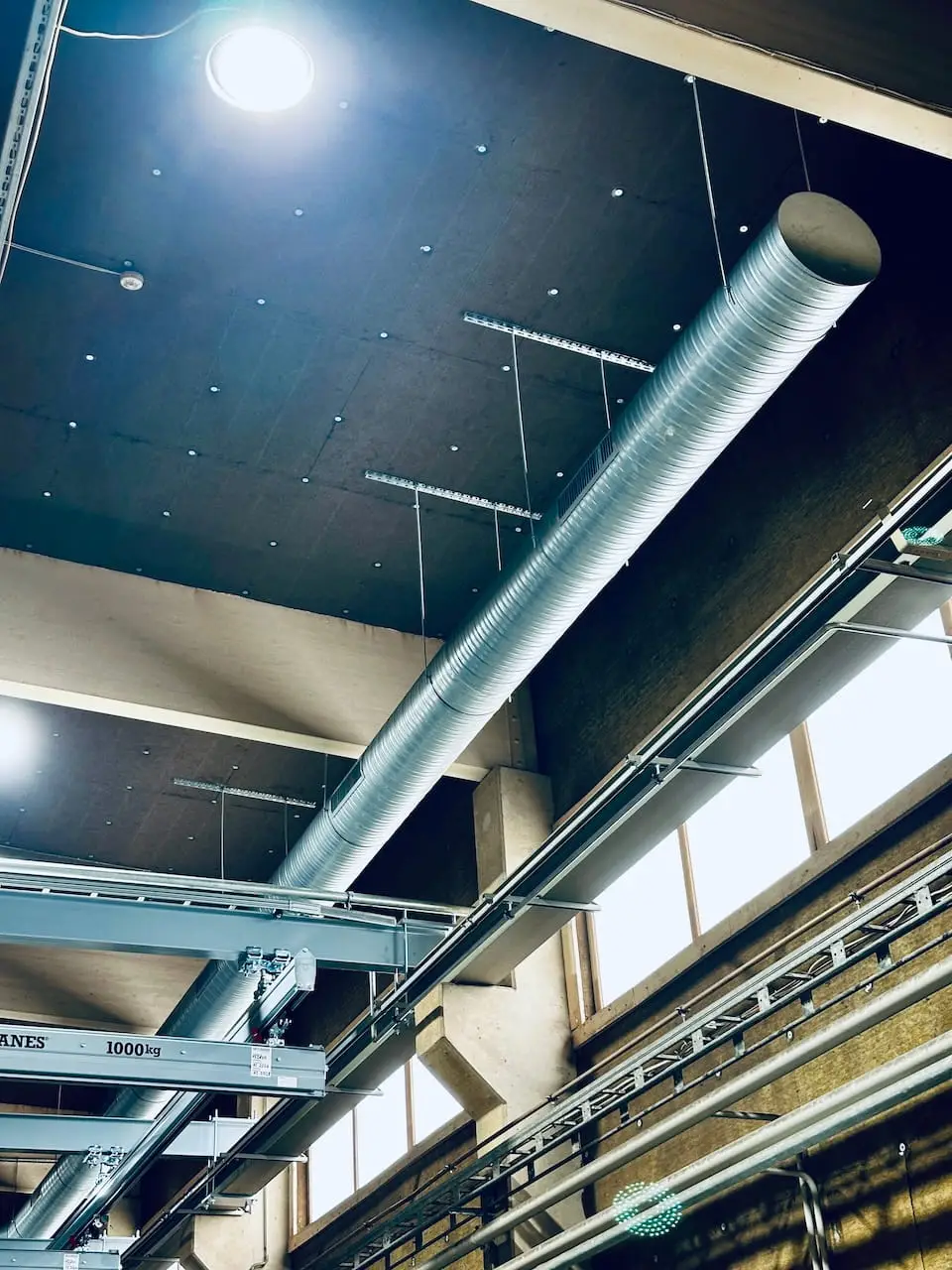
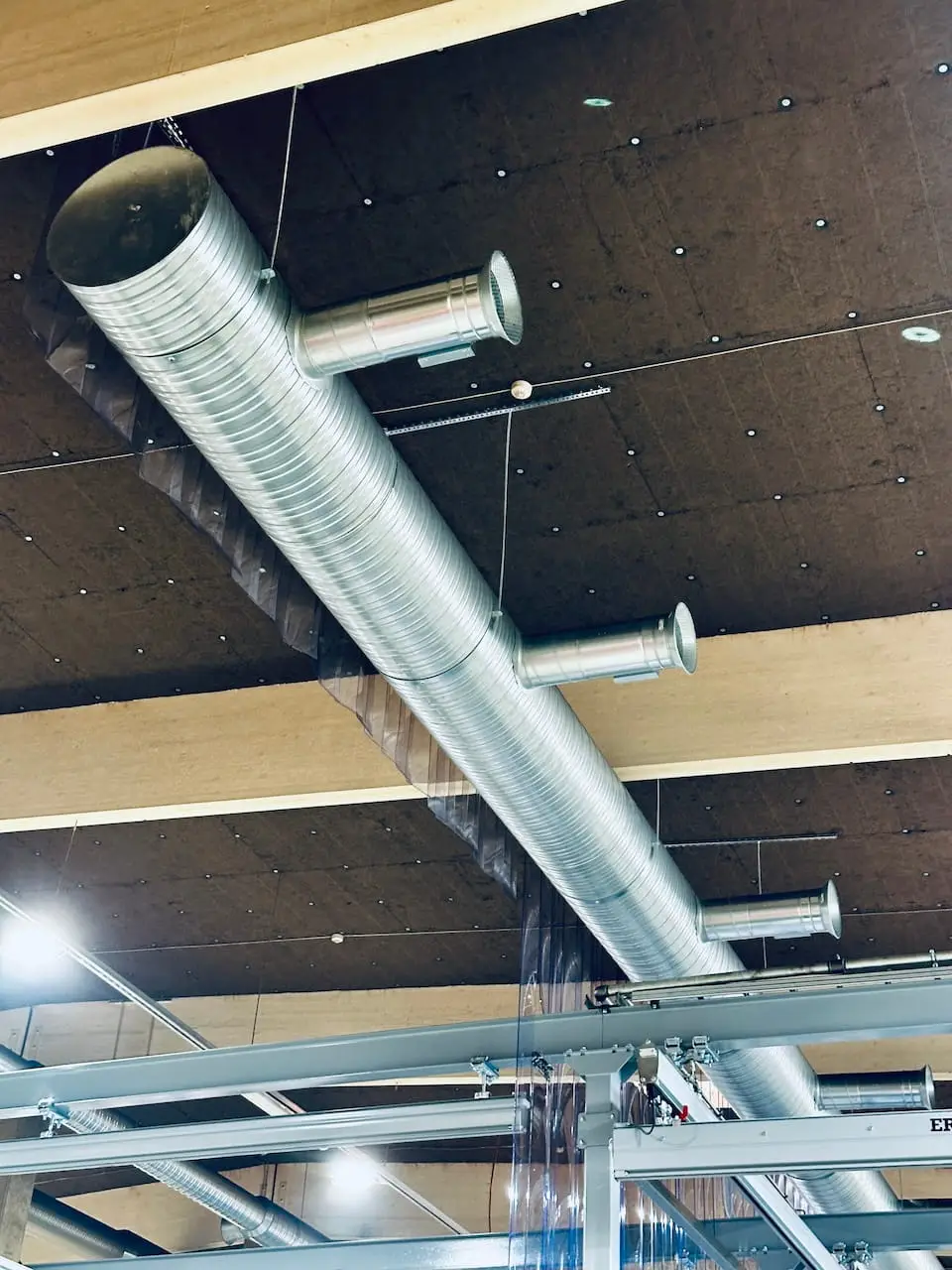
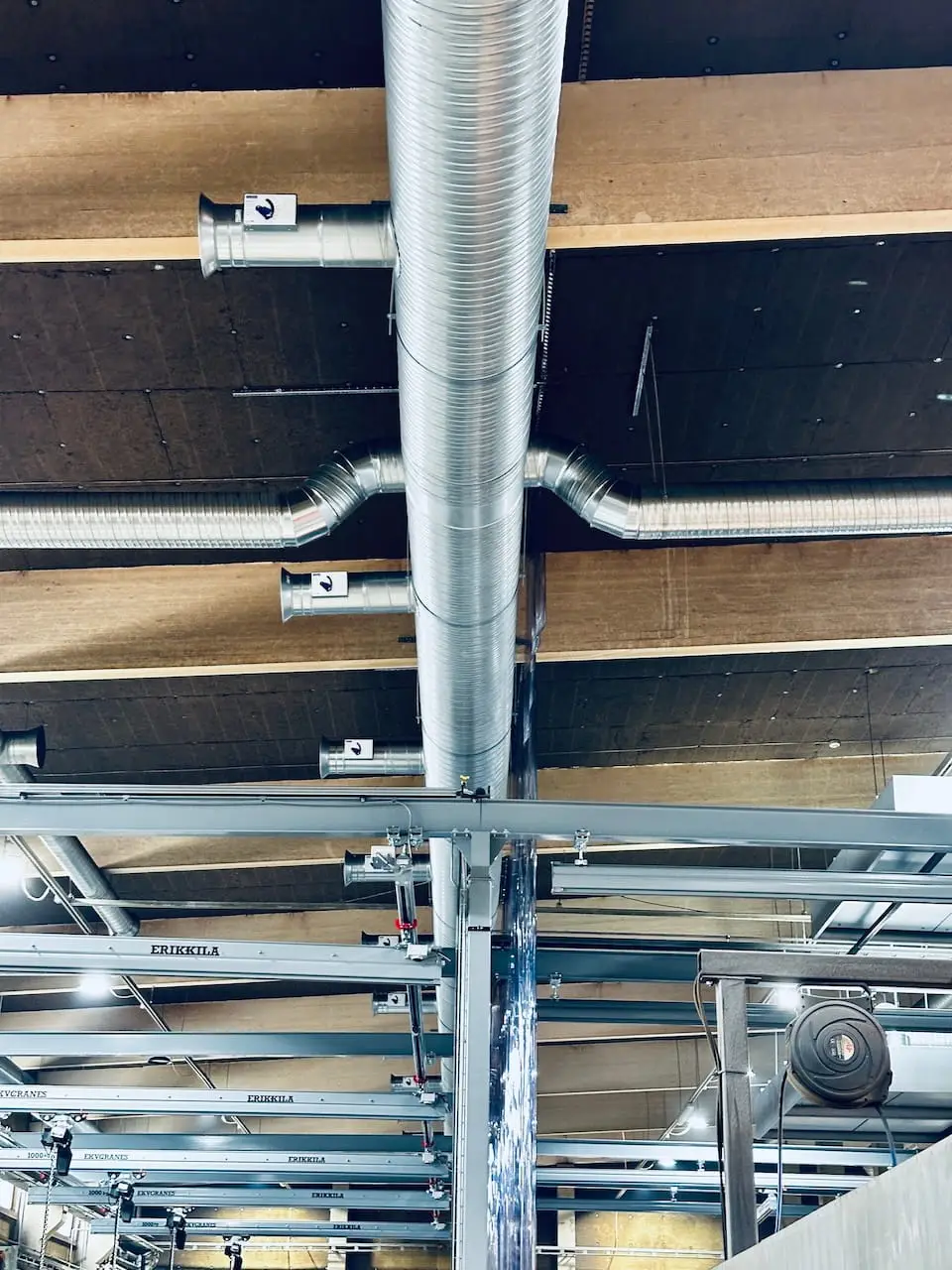
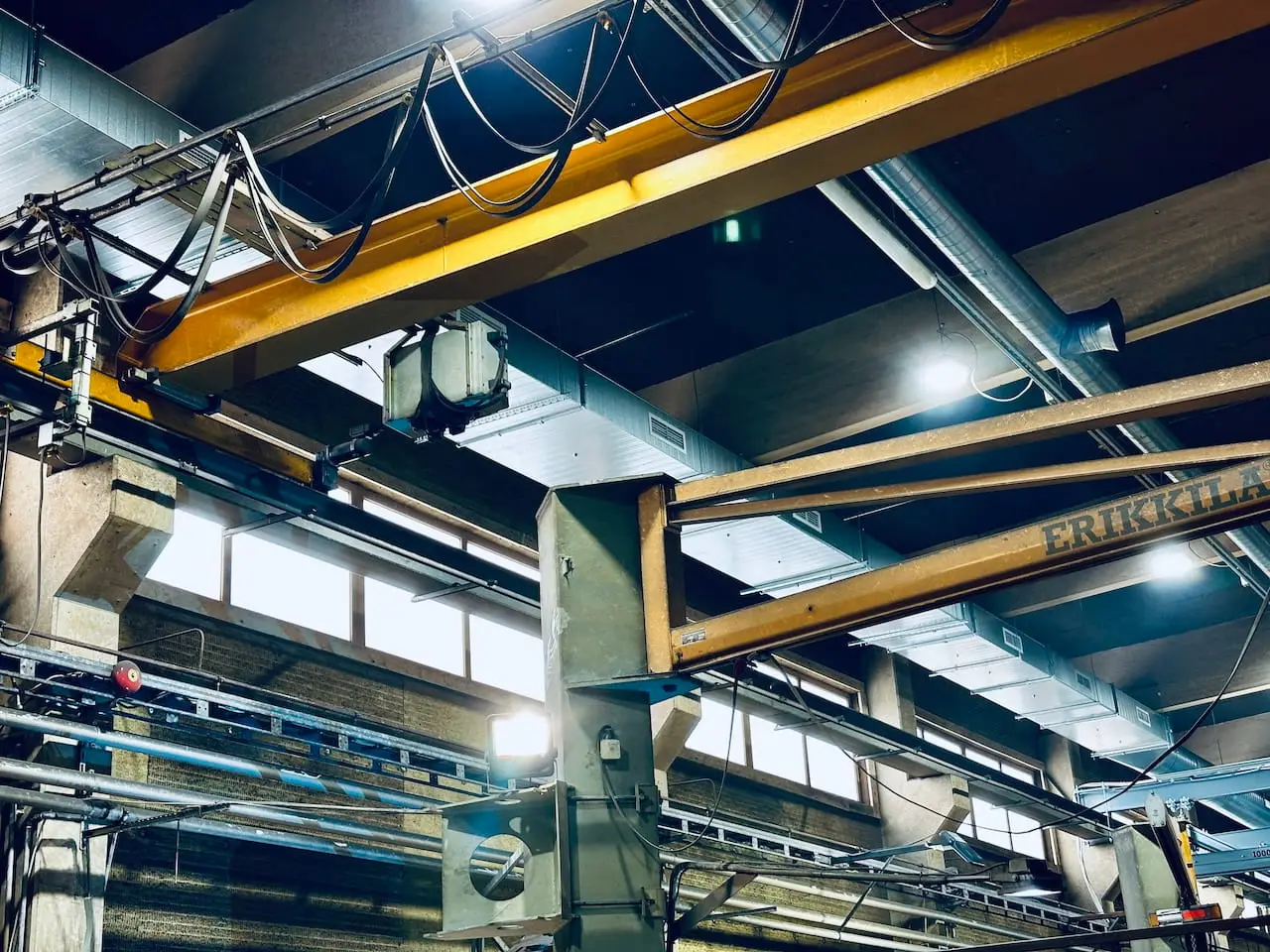
This was not a conventional welding ventilation project. In the manual welding area, the welding fumes had to be directed towards the central part of the building, where the fermi area was open and the risk of fumes spreading throughout the production area was high.
The central logic of the project was clear: manual and robotic welding could not be solved with a single system.
That's why we designed two separate systems with different air volumes, control and operating logic.
We tackled the 10-workstation manual welding area by. push-pull method, but the situation was different for this project. The welding fumes had to be channelled towards the central part of the building, where the fermi area was open and the risk of the fumes spreading throughout the plant was high. The area to be ventilated was only half of the production area.
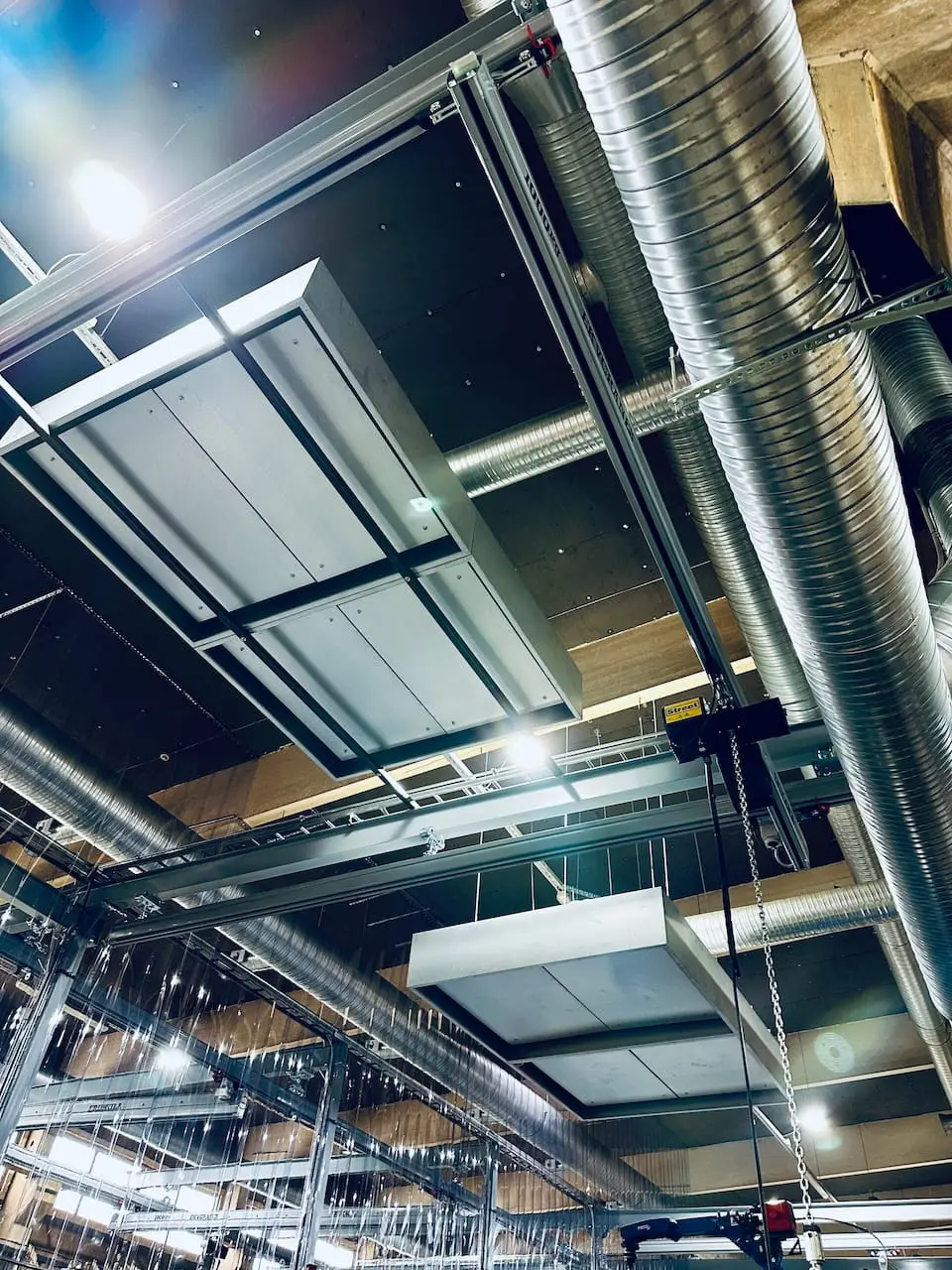
Therefore, when designing, particular attention had to be paid to the operation of the air intake. evenly throughout the pipeline and air movement is controlled throughout the work area. In addition, a practical way had to be found to limit the spread of smoke and keep it as contained as possible in the occupied zone.
The result was not just “air removal”, but a solution with controlled air movement to help direct welding fumes to the right zone and reduce their spread to the rest of the production area.
For this project, a standard approach was not enough. Due to the open Fermi area, the smoke propagation had to be controlled more precisely and the balance of the whole system was critical.
The solution used in this project is tailored to the needs of the site - taking into account both the specificities of the space and the requirements of the work process. The details that make the solution efficient and reliable in practice are described in more detail below.
The robotic welding area was given a separate system, as robotic welding differs from manual welding in terms of the nature of the smoke generated, the location of the work area and the control of the system.
In robotic welding, fumes are usually generated in a fixed and repetitive work area. This allows for a more accurate dimensioning of the fume extraction and the linking of the system control to a specific work process. A separate solution ensures that the operation of the robotic area does not depend on the load of the manual welding area.
A single common solution would not give the best result for both. A separate system allows for more accurate set-up, more stable operation and easier maintenance.
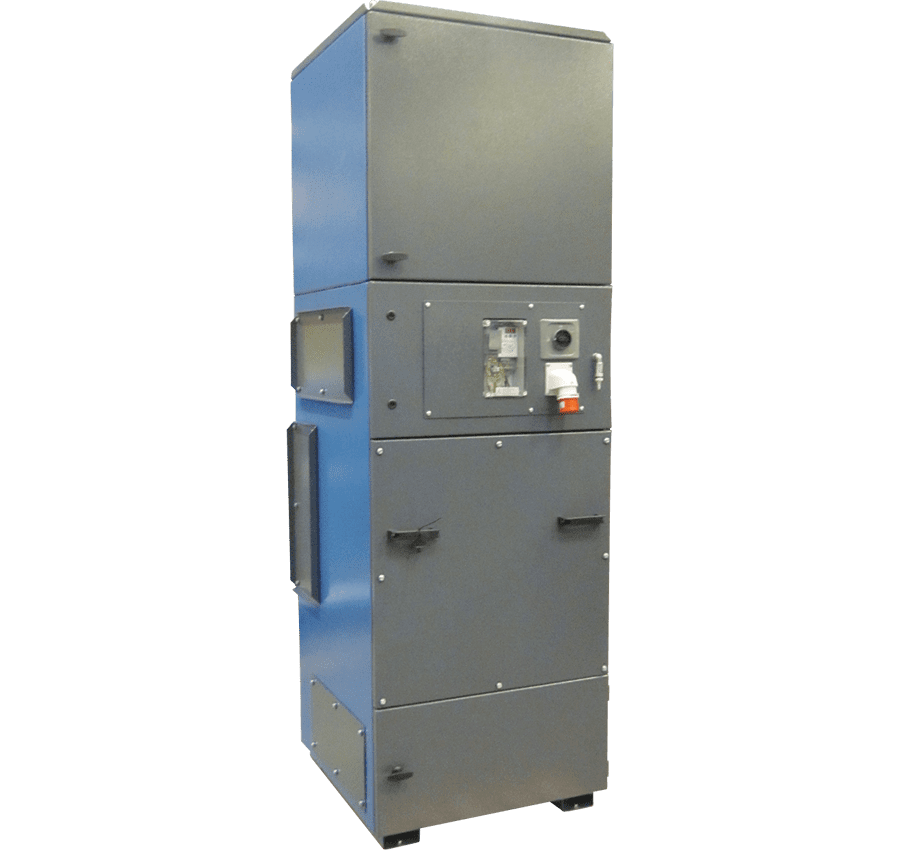
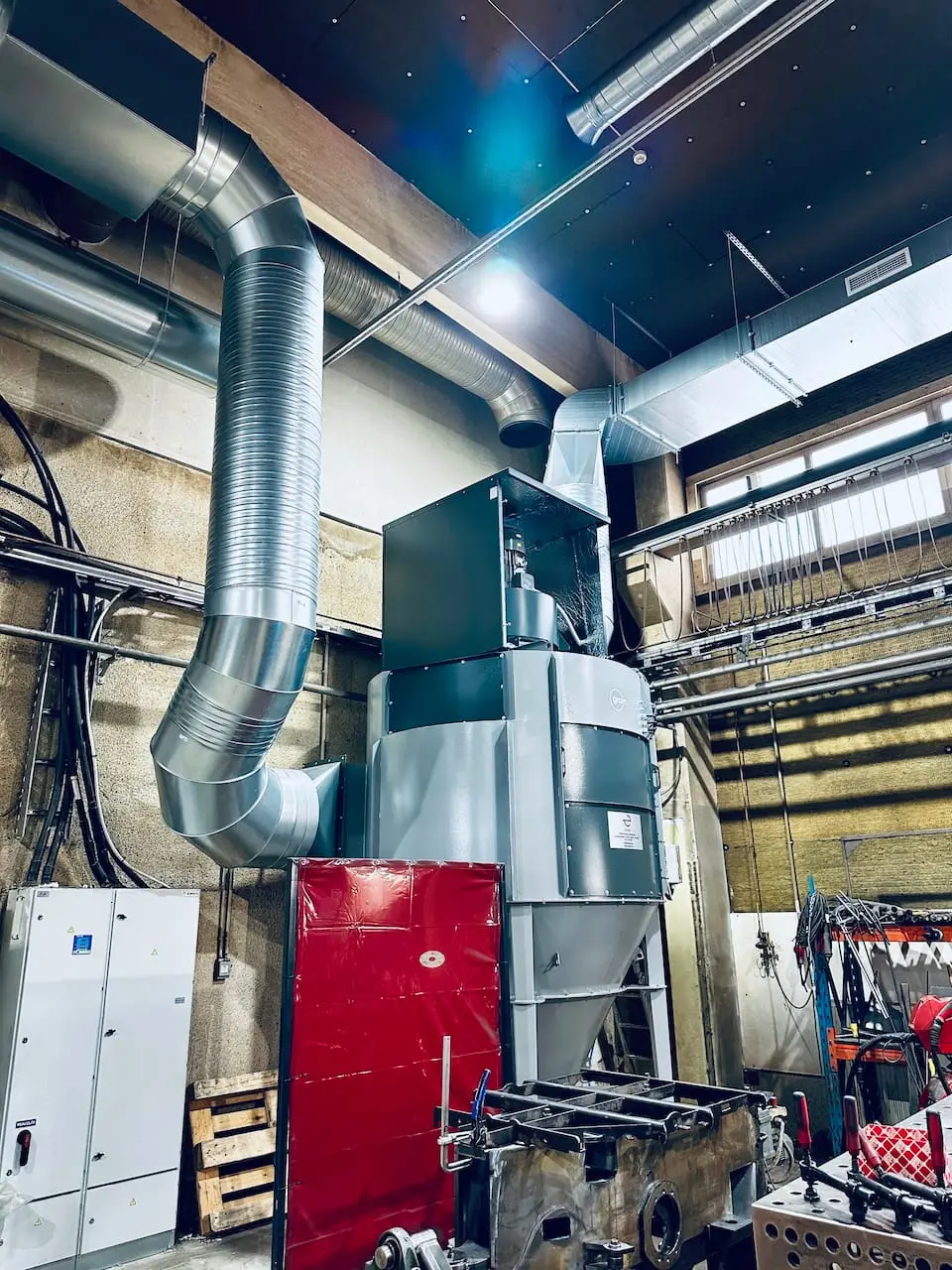
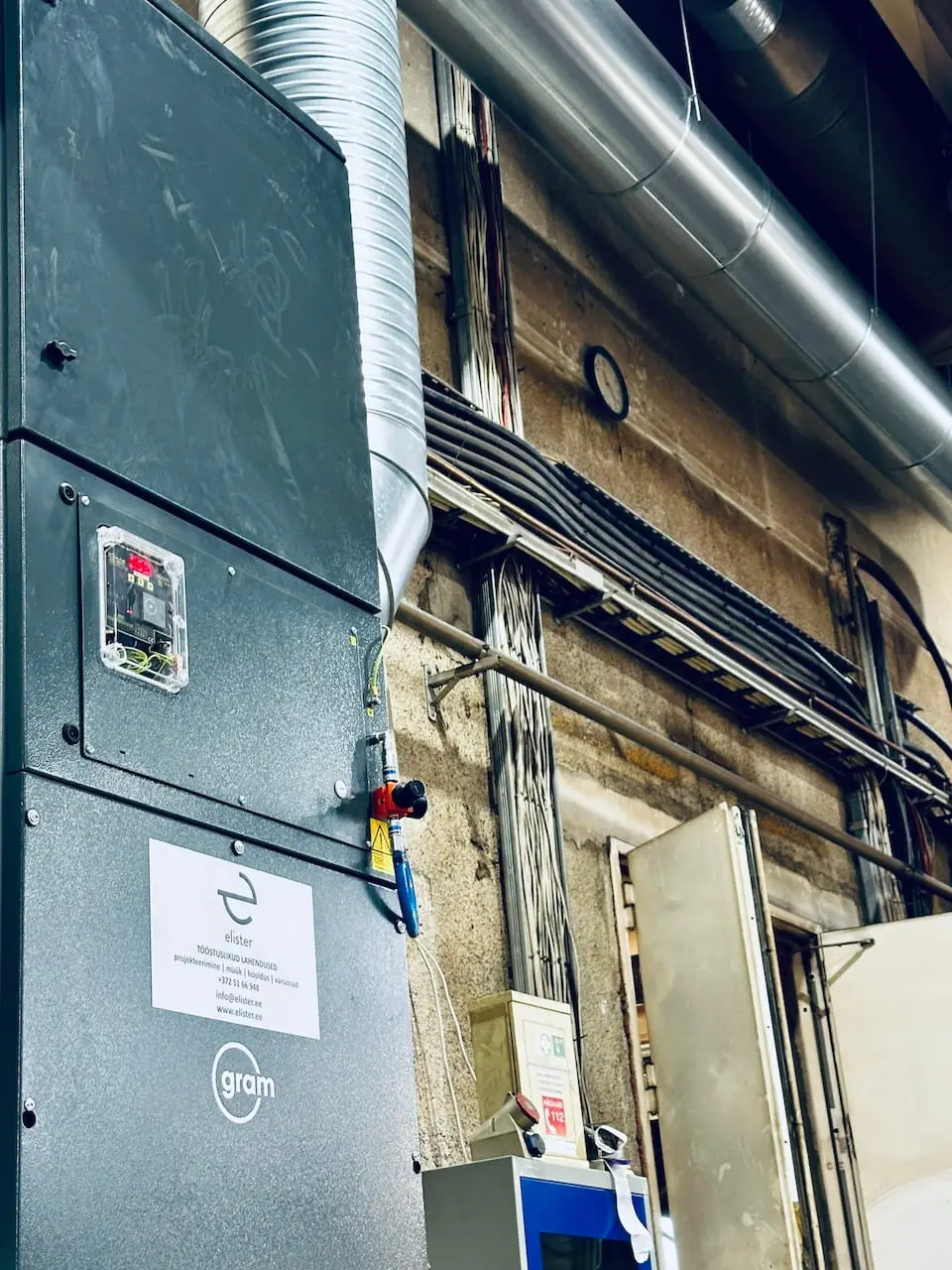
Space-saving “Plug & Play” filtration unit with integrated fan for air filtration in dusty environments. Ideal for filtering air from welding, cutting, grinding, etc. filtration. The unit is supplied ready for use, being
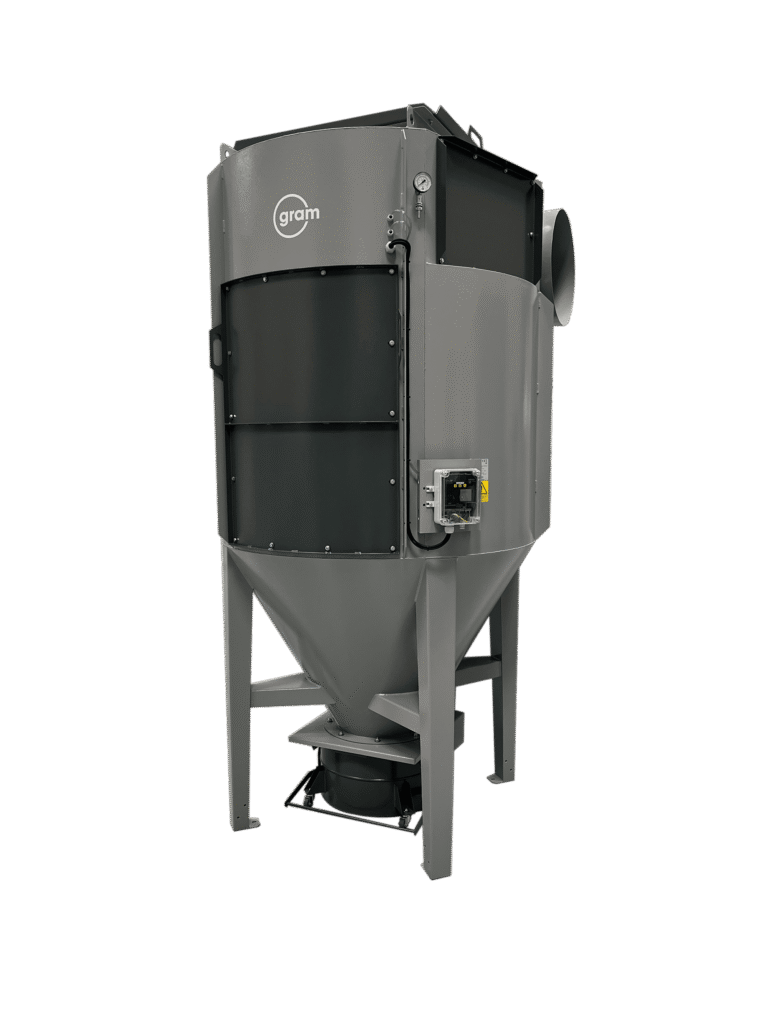
Optimised capacity filter for various larger filtration tasks. The filter is used to filter welding and cutting fumes, grinding dusts and various exhaust air containing dusts of metal, stone, plastics, etc. or various powders.
Space-saving “Plug & Play” filtration unit with integrated fan for air filtration in dusty environments. Ideal for filtering air in welding halls. The unit is supplied ready for use, equipped with forklift loops.
Read more about the company: www.metallitoostus.ee
The function of the welding ventilation system in robotic welding is to suck out residual fumes from one specific area, while in the push-pull system ventilates a larger working area.
The result is a controlled welding ventilation system that keeps exhaust fumes controlled throughout the work area and prevents them from spreading to the rest of the shop floor, while workers have access to air that is constantly purified of residues..
Manual welding is a mobile and changing job: the welder changes places, works on different parts and the smoke generation is irregular. Robotic welding, on the other hand, takes place at a fixed location, with predictable intensity and work cycles.
The two systems require completely different control logic and airflows, so a common system would not resolve the situation in a satisfactory way. In addition, separate systems work more efficiently, are more controllable and save energy.
The exact air volumes are calculated individually for each project, based on the welding process, the layout of the workstations and the additional materials. It is important to keep an eye on the size of the entire work area and the intensity of the work, and not to forget the fresh air solution in the area. In general, the air exchange in a 10 workstation manual welding area is between 12 000 and 18 000 m3/h.
Properly designed welding ventilation will increase heat loss from the room.
For this project, proper and efficient filters have been used to clean the air from residues and return it to the production process. It will certainly be necessary to address the fresh air intake through the ventilation aggregate, and if Elister installs this unit, the heat recovery there will be in the 80% range.
The choice of filtering device would be made at the design stage, depending on the amount of air to be cleaned, the nature of the work - in other words, the type of filter material to be used.
Elister recommends the use of W3 compliant filters that are easy to maintain. It is also important to check whether the equipment is hand-welded or robot-welded.
A welding ventilation project of this size will take 2-4 months in total, but industry downtime is minimal. First, we carry out a design, where we create a 3D model of the planned situation. In total, a larger project can take up to 3-4 weeks including installation.
The process consists of: design and drawing, supply of equipment and on-site installation, which is carried out in stages without major disruption to production (if necessary, the nuances are agreed with the customer). In the final phase, there is set-up and handover. Each project is individual - the exact timetable depends on the site and the availability of equipment.
Project Manager
Got a question or want to discuss a similar solution in your own production area? Contact me or send a request via the contact form.